I was asked to do a talk on sustainable design methodologies and tools for the DAS conference. I shared some of the work I have been doing in this area.
Why do we need sustainable design methodologies and tools?
Data on the progress towards achieving climate change targets and the Sustainable Development Goals indicate we are doing very poorly. More rapid transformation is required and we need to consider new approaches and more rigorous application. We cannot continue on current development pathways.
How may sustainable design processes and tools be different from what we currently use?
Currently, Architects are often under pressure to design rapidly. They have limited time to develop designs and so tend to resort to conventional unsustainable solutions.
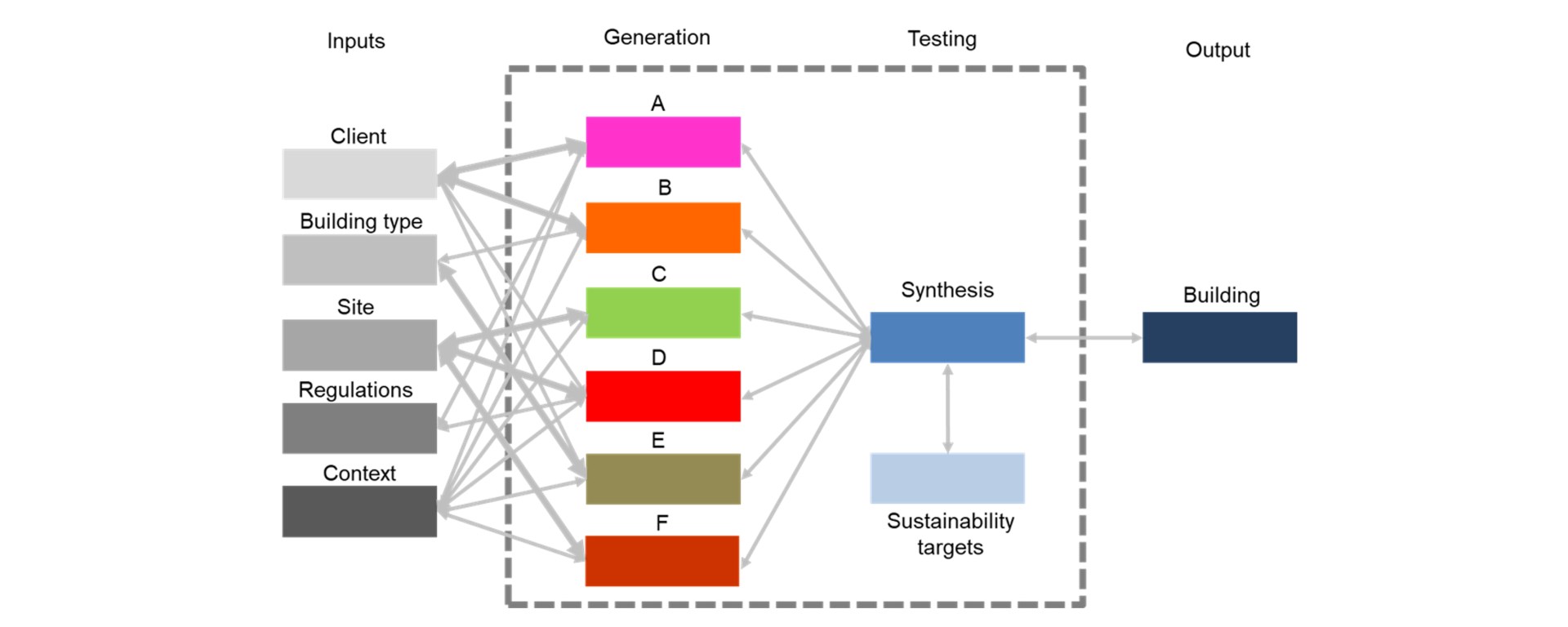
Designing for sustainable solutions looks more like the diagram above. Challenging, science-based sustainability targets are set and agreed upon with the client and the full design team at the outset. Time is provided to develop and test solutions in an iterative way until solutions that achieve targets are achieved.
What are some examples of sustainable design methodologies and tools?
- Sufficiency Investigation, Gain and Notification (SIGN): This methodology explores the potential for sustainability performance improvements through fairer science-based targets.
- Circular Economy Design Evaluation (CEDE): This tool and methodology identifies and explores the potential of circular economy options to improve sustainability performance.
- Enhancing Site Capabilities and Performance (ESCAPE): Through detailed investigation of site characteristics and capabilities, this methodology supports regenerative approaches where buildings and systems are coevolved with natural systems.
- Climate Adaptive and Responsive Design (CARD): This methodology uses modelling software and climate data to develop designs and passive strategies that are highly attuned to local conditions.
- Building Interface Design and Environments (BIDE): The sustainability performance of buildings is highly dependent on building management and users as well as the building itself. This methodology develops designs, interfaces, systems and capacity that aim to ensure that occupant behaviours and habits and building management align and support sustainability targets.
- Creating and Retaining Value (CREVA): This methodology supports the creation of higher value buildings and building assemblies which are more adaptable and responsive, have a longer service life and are easier to manage, maintain, repair and deconstruct at the end of their useful life.
These methodologies and tools are being developed in research and live projects. Please contact me if you would like to explore using any of these. I look forward to sharing updates in future.
 Jeremy Gibberd