Limited resources mean that we need to think more carefully about how much space we provide in buildings. Overprovision results in inefficient space use and owners and occupants bearing disproportionately high costs for heating, cooling, lighting and maintaining space. Over consumption in one area also results in resource limitations in others and increased costs. This means that spaces must not be too small, but also not too big – they need to be the right-size. What is the right size? How do you go about ‘rightsizing’ buildings? The idea of sufficiency is useful for this.
Sufficiency can be described as “measures and daily practices to avoid the demand for energy, materials, land, water, and other natural resources over the lifecycle of buildings and goods while delivering wellbeing for all within planetary boundaries” (IPCC) 2022.
Achieving well being within planetary boundaries will require built environments to become far more efficient. They will also need to be designed to promote daily practices that avoid demand for energy, materials, land and water.
While this is complex, one of the simplest ways of making cities and buildings more efficient is through increased densities and optimized space provision. Increased densities provide for more affordable, efficient and accessible services. More compact spaces accommodate occupants and activities more efficiently and reduce costs and resource consumption.
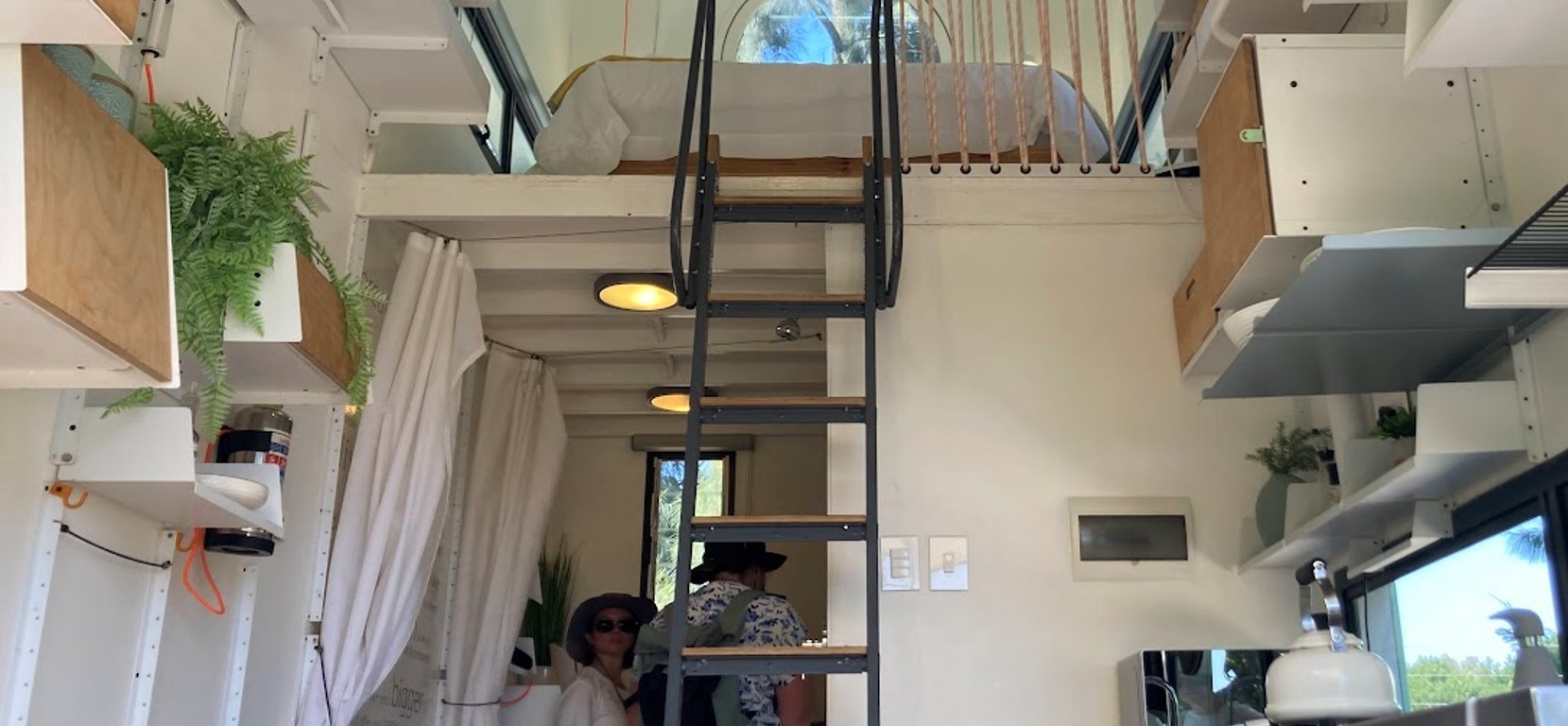
Interest in the benefits of smaller spaces and lower operating costs can be seen in the rapid growth of tiny houses. These are houses that have a floor area of under 37m2 and may be transported on a trailer or truck. Their small footprint and framed structure mean that they can built in back yards, left-over urban spaces and steeply sloping sites.
Visiting tiny houses and tiny house developments are useful in providing insights into more sufficient living and working patterns and there are an increasing number of sites around South Africa. Often these are prominent on social media, so can be easily found.
A big thank you to the Pretoria Institute for Architecture for organizing a field visit and for the owners, architects and builders for making time to explain the rich assortment of tiny houses at Rosemary Hill. The house in the picture is by Clara Cruz Almeida.
 Jeremy Gibberd