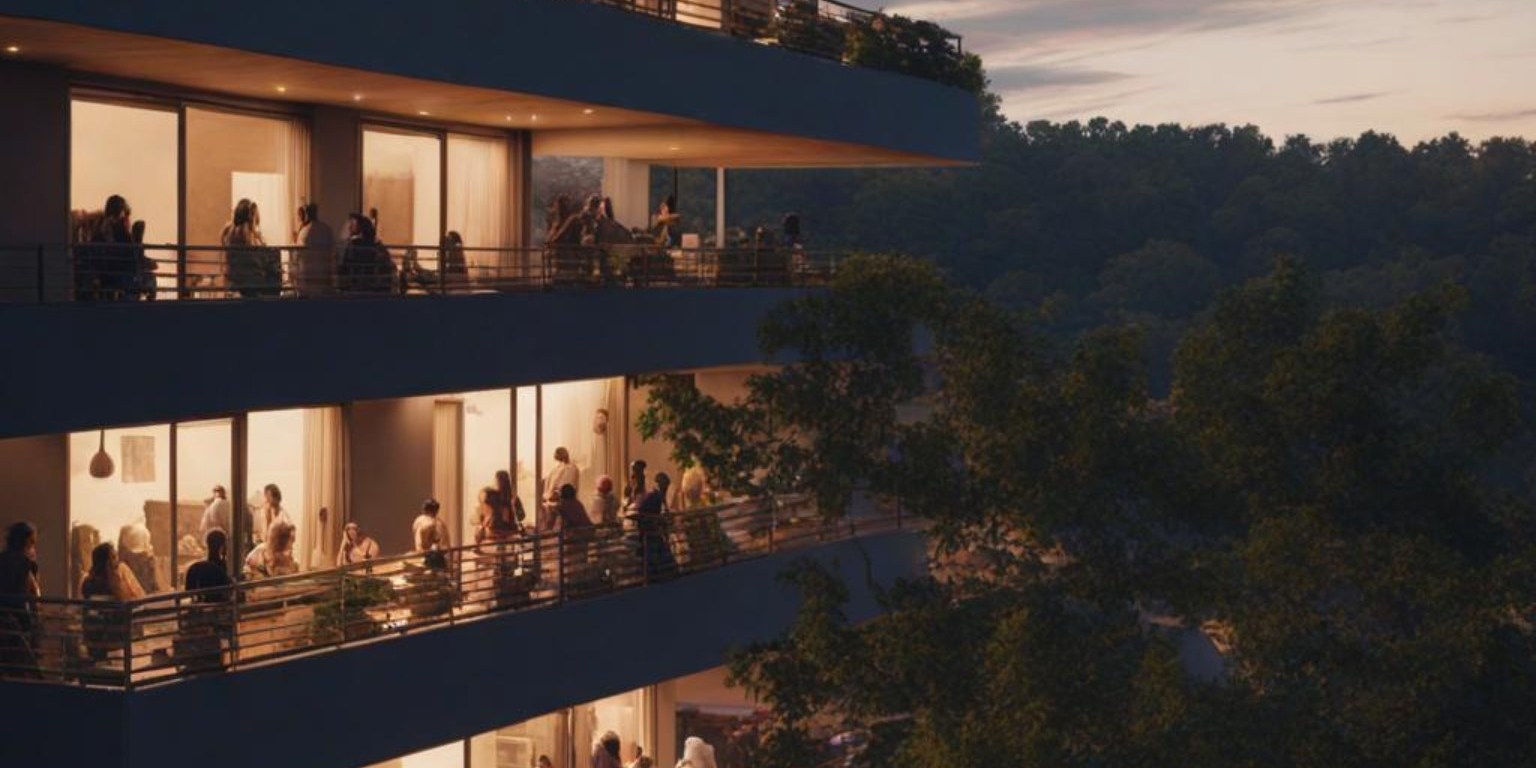
One of my contributions to the City Centre Sustainable Housing Competition has been a presentation on ideas and tools for sustainable building design.
There are often attempts to make conventional designs ‘green’ or ‘sustainable’ by adding checklist items like rainwater harvesting and bicycle parking. However, this misses many opportunities to generate buildings with far higher levels of sustainability performance.
Generating high-performance sustainability buildings requires a different approach. It includes understanding and analysing sites and their surroundings in ways that enable existing capabilities and resources to be drawn on and focussed to improve the efficiency of designs. Design briefs include science-based global sustainability targets. Alternative methods that draw on other disciplines such as ecology are applied to create high-performance integrated systems. A key goal is not the construction of inert objects but the provision of facilities and systems that encourage, enable and ensure more sustainable living and working patterns.
So, what does this mean? The approach can be illustrated through some examples.
Site characteristics and capability
Highly sustainable buildings draw on and work with, existing characteristics and capabilities of sites and their surroundings. So on the competition site, what are the site’s characteristics in terms of climate and topography? Can existing solar, rainwater and thermal capabilities be drawn on and focussed in the design? What activities take place on and around the site? Can locational and spatial capabilities of the site be directed to promote more sustainable working or living activities within and around the site?
Systems
Developing sustainable buildings requires seeing things differently. In addition to static plans and sections, system diagrams with flows can be used. This provides for alternative more dynamic perspectives and reveals opportunities. For instance, diagrams could be used to explore more ‘loopy’ circular systems, such as the inclusion of greywater systems, to improve efficiency and avoid waste.
Time
Developing sustainable built environments requires an understanding of buildings as dynamic systems that constantly change. Visualising activities on a site over time can help improve sustainability performance. For instance, what are the flows of stormwater on site after heavy rain? Are there ways of retaining flows on the site, for instance, by using turf roofs or rainwater harvesting tanks, to avoid contributing to large peak flows and flooding in municipal drainage systems?
Change
The pace of change and levels of uncertainty are increasing. Buildings that cannot accommodate this get demolished or must be extensively refurbished leading to disruption and waste. Future changes can be envisaged and accommodated through spatial, structural, and service strategies that support flexibility and adaptability. These strategies aim not only to accommodate functional changes within the building but also changes in the surrounding areas.
Circular economy
Circular economy approaches are inherently more sustainable than conventional methods and can be applied to designs in a range of ways. Are there opportunities to use more circular building products, such as bio-based materials? Can efficiencies be improved through sharing access to equipment and facilities, such as cars, printers, and washing machines, rather than these being individually owned? Can Product-as-a-Service (PaaS) approaches be used to reduce waste and encourage the development of local entrepreneurs? What is required to enable the building to be readily adapted, repaired, and maintained to keep materials and products in use longer?
Resilience
Sustainable buildings need to be resilient. This means envisaging future change and accommodating this. In developing resilience strategies, key activities and services that must continue in and around the building must be identified and prioritised. For instance, while a waste management service may be interrupted, usually the supply of water cannot. In developing resilience strategies, there may be co-benefits which promote sustainability. For instance, onsite renewable energy and rainwater harvesting systems, not only enable the building to be resilient to energy and water outages, they also enhance sustainability performance.
Living and working patterns
A goal of sustainable built environments is to enable more sustainable living and working patterns. What are the current working and living patterns of people around the site and of future occupants? What is required to make these more sustainable? What facilities, services and features can be provided in designs that enable and encourage people to live and work in much more sustainable ways? Can an evidence-based approach be developed?
Sufficiency
It is increasingly clear that technology alone will not be enough to reach climate change targets and Sustainable Development Goals. Societal transformation (in terms of lifestyles, social practices, infrastructures, etc.) is necessary. This transformation has implications for sustainable buildings and includes defining limits, for instance, in terms of the provision of space and resources per person.
Targets
Structured methodologies can support the design of sustainable buildings. This sets building targets which align with the achievement of global goals such as climate change commitments and the achievement of Sustainable Development Goals. Addressing sustainability means not only addressing environmental performance but also social and economic sustainability performance. Challenging targets provide a useful stimulus for innovation and the exploration of alternative and sometimes much more effective approaches. Options can be tested through modelling and an iterative process used to develop optimal solutions. Rigorous modelling and calculations, that take local factors into account, can be used to reduce uncertainty and help ensure that buildings achieve the required levels of performance.
 Jeremy Gibberd