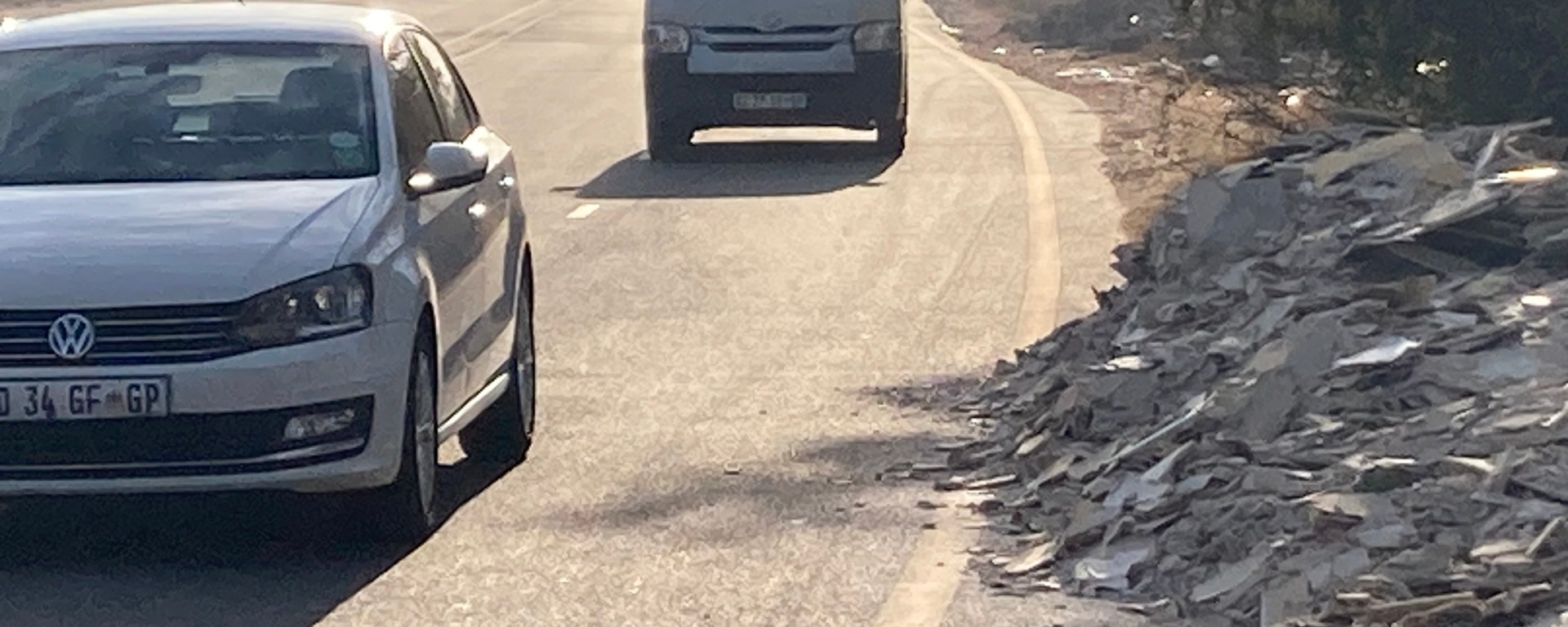
It is estimated that about 30% of the waste in many cities comes from construction. This waste often has to be transported long distances to a landfill site. This results in pollution, traffic impacts and the loss of valuable materials and space. Contractors may also take shortcuts, leading to flytipping. The picture above shows construction waste being dumped near a busy road in Pretoria, South Africa. This waste is not only an eyesore but also damages natural environments and could cause traffic accidents.
Material reuse
An investigation of the construction waste loads indicates that these are often uniform. There are loads of concrete, broken bricks, plasterboard offcuts, ceiling panels, and broken tiles. Could this waste not be sorted and stockpiled so it could be used for other purposes?
At its simplest, many of these materials could be used as hardcore and backfill and be used by Contractors instead of importing material. However, are there other uses as well? To what extent could materials be processed for reuse in new materials such as concrete blocks? Can plasterboard be recycled into new gypsum products?
Extended product responsibility
Should manufacturers and suppliers take more responsibility for the recycling of their products? Gyproc in Ireland provides skips at construction sites and picks up waste plasterboard which is then fully recycled. While this approach is increasingly common in developed countries, how many manufacturers provide the same service in developing countries?
There is an increasing interest in policy and legislation on extended producer responsibility (EPR) in countries like South Africa and Botswana. EPR focuses on the responsibility of the producer for the impacts of their product in the final stage of its life cycle, after consumption, and gives producers a greater motivation to design products that minimize environmental and health impacts.
Local initiatives
Given that policies and laws often take time to implement, can local initiatives be developed? Could partnerships between manufacturers, suppliers and contractors be developed to avoid construction waste? Could a well-managed, readily-accessible, central site(s) be developed for sorting, and stockpiling construction waste to enable this to be reused and recycled?
An effective, well-used circular construction waste system would have many benefits. The cost of construction waste disposal for contractors would be reduced and their transport impacts reduced. Contractors would also have access to lower-cost used materials and products that they could use. The cost of cleaning up flytipping and developing and managing landfill sites would be reduced for municipalities. Manufacturers would be able to access materials that they could use in new products and reduce their environmental footprints. Citizens would benefit from cleaner environments, with less traffic and pollution and flytipping. Rates and taxes paid for waste and landfill could be reduced and spent more productively elsewhere.
 Jeremy Gibberd